sexta-feira, 8 de setembro de 2017

The Steve Miller Trio - Meets Elton Dean 1985

Here's another exercise in musical archaeology from Reel and it is worthy of loud and prolonged applause. British pianist Miller was always a worthwhile player, shaping up here as he often did as the British Mal Waldron in terms of his purged-of-excess approach to the keyboard. He always kept sound musical company and the presence of both Dean and drummer Eddie Prevost testifies to that here.
Made in the moment, "Dedicated To Few" is a highly persuasive manifesto for such an approach. When the music bucks and boils it's only as an outcome of what's gone before, with each musician's powers of response really tested. For the record, none of them are found wanting. Despite the billing, this is music that willfully and indeed joyfully subverts the soloist with accompaniment trope, although anything that might imply that voices are raised in serving the end of empty cacophony doesn't apply here. Instead the optimum term could just be 'organic.'

By comparison, an exercise which all too often yields little in the way of substance for discussion, "Bishop Of Stortford" is a relatively tranquil affair. Dean here pares his lines down to the absolute minimum, his contribution both acerbic and telling. The members of the Miller trio to a man both stimulate and contribute to the many dialogs going on and the very momentum of the music seems to stem from that collective endeavor. It only goes to show how arbitrary the business of capturing 'the music' can be even while in this case listeners can be eternally grateful that it was.

In many respects there was no need for an additional recording on this one, but we get it in the form of "One For Three" with a trio consisting of Miller, Dean, and drummer, Pip Pyle. There's a host of reasons to be grateful that the music was caught, not the least of them being that it captures the two principals in a more reflective frame of mind, with Pyle showing what a good colorrist he was. Again the music has that profoundly in-the-moment feel which elevates it to another plane, and Dean in particular exploits the opportunity to show off his lyrical side. AllAboutJazz.

listen here

The Mavericks - From Hell To Paradise 1992

The Mavericks made their major-label debut with their second album, 1992's From Hell to Paradise, and while co-producer Steve Fishell added a lot more gloss than the band could summon up on their first independently released disc (not all of which works in their favor), overall this set sounds noticeably stronger and more sure-footed than the Mavericks did their first time at bat. The slicker sound certainly makes the most of Paul Deakin's sharp drumming and Robert Reynolds' rock-solid bass, and vocalist Raul Malo gained plenty of control and confidence this time out, with his clear, flexible tenor shining bright on every track, especially the plaintive "This Broken Heart" and the dramatic title song. Between the Farfisa-flavored pop of "I Got You," the rockabilly-accented locomotive charge of "End of the Line," and the Latin accents of "From Hell to Paradise," the broad stylistic range of the group's best work was beginning to make itself felt, as well as intelligent and challenging lyrical themes which set them apart from the average bunch of Nashville cats (significantly, From Hell to Paradise was recorded in that noted country music Mecca of Miami, FL). A few tunes are a bit more formulaic than one might hope for, and while the Hank Williams and Buck Owens covers are fun (and show good taste), they aren't especially enlightening. But there's enough good stuff on From Hell to Paradise to confirm the musical promise of the Mavericks' first album, and pave the way for their breakthrough with What a Crying Shame. AMG.

listen here

Shannon and the Clams - Dreams In The Rat House 2013

Shannon and the Clams' third album, 2013's Dreams in the Rathouse, signals a tiny step forward for the trio. Recorded over the course of a year in cool places like a cabin in the woods and Nobunny's practice space, the album sounds tougher and stronger than previous efforts, Shannon Shaw's vocals have a more powerful presence, and the songs are better overall. Not that there was much wrong with the jumpy, scruffy late-'50s/early-'60s rock & roll-worshiping records they had made in the last couple years. Dreams just seems to put it all together in a way those albums didn't quite accomplish. From the opening "Hey Willy," which gets things started in a happy, bouncy fashion with some excellent guitar and vocal work from Cody Blanchard, to the blown-out girl group in a wind tunnel "I Know," which ends the album with one of Shaw's best vocals, the record is all high points with precious few dips in quality. The album never settles into any one groove, throwing out doo wop dreamers, tender late-night girl group ballads, a few pounding rockers, and a genius stab at garage rock (the ferocious "Bed Rock"). There are a couple times when the band's frenetic playing gets them in trouble and things go off the rails a bit, but mostly they keep things under control and deliver the trashy goods. Blanchard and Shaw's vocal interplay is much improved, too, and while they sound excellent on their own (Blanchard snappy and raw; Shaw with a booming, pushed-close-to-the-breaking-point intensity), they sound made for each other on the songs where they share vocals. The ballads sounds especially good; when the tempo slows and Blanchard's twangy guitar has some space to play, it gives Shaw's heartbroken vocals a chance to truly shine. Check her out on "If I Could Count" or "Unlearn" -- she could have been a Shangri-La, no problem. That she doesn't totally overshadow the rest of the band, and that the songwriting matches her vocal prowess, is a testament to how good Shannon and the Clams are on Dreams in the Rathouse. Quite a few people are doing this kind of music in 2013; precious few are doing it this well. AMG.

listen here

quinta-feira, 31 de agosto de 2017

Naam - Naam 2009

There are very few bands in the known universe that you can say draw upon such varied influences as the StoogesHawkwind, and Can. But the Brooklyn, NY trio, Naam, certainly fits the aforementioned bill. On their self-titled 2009 debut, the group issues a vintage-sounding offering that manages to include elements of stoner rock, garage rock, and psychedelic star-gazing. Think of Monster Magnet's early work, and you're not far off from what these lads sounds like. Like all good stoners, you get an obligatory never-ending, mammoth track -- "Kingdom" -- which in this case kicks off the album (and starts with nearly five minutes of swirling wind sound effects). Elsewhere, you'll find a track that sounds like Mudhoney's Mark Arm fronting the aforementioned Monster Magnet ("Skyling Slip"), while quite a few unmistakably Sabbath-y grooves appear throughout (especially in the middle of "Icy Row"). Unlike other stoner metal acts that appear content to play the same riff for minutes on end through a bong-smoke haze, Naam offers enough twists and turns to keep it interesting. AMG.

listen here

Eurythmics - Be Yourself Tonight 1985

On Be Yourself TonightEurythmics' most commercially successful and hit-laden album, the duo meticulously blended the new wave electronic elements that dominated their previous sets with the harder straight-edged rock and soul that would dominate later sets to come up with a near-perfect pop album. This disc scored no less than four hit singles and kept them a mainstay on MTV's play lists during the channel's heyday. Fusing pop, soul, rock, electronic beats, and even gospel, this is arguably the duo's finest moment. The first hit, "Would I Lie to You," is a straight-forward rocker, complete with great guitar licks, a soulful horn section, and Annie Lennox sounding as vicious and vivacious as ever. The second single, which was a huge chart topper in Europe, "There Must Be an Angel," is nothing short of shimmering beauty, with Lennox providing truly angelic vocals and Stevie Wonder lending an enchanting harmonica solo. Aretha Franklin lends her powerhouse pipes for the duet "Sisters Are Doin' It for Themselves," which has gone on to become an immortal feminist anthem. From the soulful electronic beats (a rarity) in "It's Alright (Baby's Coming Back)" to the beauty of the Elvis Costello duet "Adrian" to the pain and longing of the sorrowful rocker "Better to Have Lost in Love (Than Never to Have Loved at All)," this album runs a wide array of musical styles, each song standing tall on its own two feet. This disc is, without a doubt, one of the best rock/pop albums from the 1980s and one of the grandest, most creative albums delivered by the ever-appealing and innovative duo of Annie Lennox and Dave Stewart. A true classic. AMG.

listen here

Cosa Brava - The Letter 2012

Writing at All About Jazz, John Eyles described The Letter as "transcend[ing] genre", and Frith's songs as "melodic ... provid[ing] the group with plenty of scope for embellishment". He said the album "hangs together well", adding that Kihlstedt's violin has "inflections carrying great emotional weight", and Frith's guitar as "fluid [and] interwoven with wordless vocals, to stunning effect" on "Common Sense".

listen here

Dalis Car - InGladAloneness (2012)

Dali's Car was a duo project of bassist Mick Karn (formerly of Japan) and vocalist Peter Murphy(formerly of Bauhaus); it came into existence in the mid-'80s, produced one unsuccessful album, and then fell apart amid mutual rancor. But in 2011 Karn and Murphy tried it again. Karn was terminally ill, and they only came up with three new songs. (The five tracks on this EP include a cover of Jacques Brel's "If You Go Away" and an arrangement of a traditional Turkish song.) Those who recall the group's earlier work will probably experience a familiar frustration: wishing that Murphy would knock off the pseudo-operatic vocalisms so that they can better hear the brilliant and utterly unique basslines that Karn keeps spinning out. The music itself is consistently both interesting and attractive, self-consciously "exotic" but so tonally and melodically inventive that its occasionally twee gestures are easily overlooked. But Murphy's vocal style is simultaneously silly and self-important, and he doesn't contribute a single worthwhile melody or memorable turn of phrase. For Mick Karn's fans, this EP constitutes a bittersweet and deeply flawed farewell, but it also shows that he was operating at the peak of his powers as a bass player even at the end of his protracted illness. AMG. 

listen here

Babajack - Live Summer 2015

‘Babajack Live’ starts out as a blues album – all wailing harp, rough-hewn slide and hypnotic rhythms on homemade instruments – but quickly develops organically into a body of music with more depth.
The background to the album is that it was originally meant to be recorded at the Albert Hall, but circumstances dictated otherwise, leading to a last minute change of venue.  In that context both the band and producer Paul Long have done remarkably well to nail an essential live album full of Becky’s edgy vocals,  the ensemble’s rip-roaring percussive style and their inspired interplay.
The band explores layers of expansive Afro-rhythmic textures with a Delta blues feel, shot through with a rocky edge.  The kick ass rhythm section of drummer Tosh Murase and Adam Bertenshaw push vocalist and percussionist Becky Tate and the harp playing guitarist to the limit.
It helps of course that their material is an amalgamation of roots-rock, blues and folk that some might call tribal fusion.  It’s a musical hybrid that readily lends itself to their intense version of ‘Gallows Pole’, a number that runs the full gamut of styles from folk to blues and rock. It’s easy to identify Babajack as a jam band who eschew structure for feel and spontaneity. But that would be to overlook their musical complexity, comprising sudden tempo changes and a subtle use of dynamics that gives tracks like the extended ‘Coming Home’ its impact. Thanks to B.


listen here

A Giant Dog - Pile 2016

Following a pair of spirited self-released outings, Austin punk outfit A Giant Dog make their Merge Records debut with Pile. With Spoon producer Mike McCarthy at the helm, the band's boozy, glammy garage punk gets a subtle studio makeover, though it would be a stretch to call the overblown crunch ripping through the speakers polished. Fronted by co-singers/songwriters and Houston natives Sabrina Ellis and Andrew CashenA Giant Dog retain their knack for pairing relatable melodies with sweaty, full-bore intensity, avoiding the more predictable leather-panted rock swagger in favor of weirdo party-rock inclusiveness. Their targets are the freaks, geeks, and general outsiders, much like themselves. Pile's press release name-drops a host of colorful '70s characters like SladeSparksMarc Bolan, and Alice Cooper, and as far as comparisons -- or more likely influences -- go, they're more or less on the money, albeit with more of a punk approach. Freewheeling standouts like lead single "Jizzney" and the especially glammy "& Rock & Roll" are equal parts sugar and grime and 100 percent fun. Likewise, the sizzling brass-adorned boogie rock of "King Queen" and the defiant punk of "Too Much Makeup" have hooks for days and the kind of energy that can only be summoned from the heart of the beer-soaked club scene. The album's only real dynamic shift comes near the end with the acoustic psych of the Tyrannosaurus Rex-esque "Get with You and Get High." It's a nice breather on an album that, in spite of its highlights, sticks around about three or four songs too long. A Giant Dog aren't necessarily offering anything that hasn't been done before, but Pile is definitely a fun listen with enough bright spots and kinetic energy to sustain it. AMG.

listen here

Djelimady Tounkara - Solon Kôno 2005

The lead guitarist for the Rail Band from 1971 to 1979 and 1984 on, Djali Madi Tounkara played an important role in the evolution of West African music. Known for his unique guitar tunings, Tounkara has continued to influence the music of his homeland. Tounkara's attempts to attract global attention, however, have left him frustrated. Scheduled to participate in the recording sessions that produced the award-winning album Buena Vista Social Club, he was kept from the sessions when his passport arrived late. After performing with L'Orchestre National 'A' De La Republique Du Mali in the late-'60s, Tounkara joined the Rail Band in 1971. He remained essential to the band's sound until 1979 when he, along with guitarist/vocalist Mory Konte, left to form their own band, L'Orchestre Super Rail Band International. The group recorded one album, Affair Social, in 1980.
Since reuniting with the Rail Band in 1984, Tounkara has remained active with the group, performing every Saturday night at the Buffet Hotel de la Jare. Tounkara has continued to explore a variety of forums for his music. In 1992, he joined with guitarist and president of Mali's musicians union Bouba Sacko and former Rail Band singer Lafia Biabate to record an all-acoustic album, Big String Theory. AMG.

listen here

Bill LaBounty - Bill LaBounty 1982

Bill LaBounty is an American musician. He was initially a singer-songwriter in the soft rock genre, first as a member of the band Fat Chance, and later as a solo artist. As a solo artist, LaBounty recorded six studio albums, including four on Curb Records/Warner Bros. Records. His first chart single, "This Night Won't Last Forever", was covered in 1979 by Michael Johnson, whose rendition was a Top 20 pop hit that year.

In the 1990s, LaBounty shifted his focus to country music and has co-written several songs for country music artists, including Steve Wariner's Number One hits "Lynda", "The Weekend" and "I Got Dreams". LaBounty signed to a songwriting contract with Curb Publishing in 2001.

listen here

Ana Tijoux - Vengo 2014

Though French-Chilean Rapper Ana Tijoux has been making music since the late 1990s, she is best known for 2010's 1977 and 2012's La BalaVengo is her third release for Nacional. Neither as melancholy as 1977 nor as outwardly angry as La Bala, it is far more ambitious musically and lyrically. Over 17 gorgeously constructed tracks, this music moves seamlessly between hip-hop, old-school cumbia, Andean mountain folk, digital dub, brassy funk, soul, pop, rhumba, and jazz, and all are at Tijoux's command, in any combination she desires. There are no samples; the full band and voices were cut on the studio floor. Overdubs were added later. There is far more singing here than we're used to from Tijoux and that's a great thing. The title track is introduced by soft Andean flutes; their poignancy is a far cry from those found on new age or world fusion records. They are met by a skittering drum kit, loops, brass, and Tijoux's strident boom-bap rapping about the dignity and pride of her Mapuche family. "Antipatriarca" is a feminist anthem driven by nylon-string guitars, hand percussion, and flutes, with an expansive brass section -- including French horns and flügelhorns -- adding dimension and color. In addition to rapping, her lovely contralto joins the mix, wedding jazzy soul, mountain folk, and flamenco. 
Bluesy funk led by rolling snares and an electric guitar vamp underscore an indigenous male chant in "Rio Abajo." When she begins to MC, flutes and strummed nylon-string guitars join hand drums under her rap about water as the metaphor and source for all life and love. She joins the chorus of men and women singing at the end. Though introduced by an acoustic guitar, "Los Peces Gordos No Pueden Volar" melds horn-driven funky soul to bumping hip-hop. She croons as well as raps about the lessons of motherhood and offers advice to her daughters as an Indian sub-melody unfolds under the R&B. There are some excellent guest spots here as well: longtime colleague and producer Hordatoj helps out on the fierce, uplifting "Somos Todos Erroristas," that underlines the role mistakes play in making us human, and as necessary for both transforming and transcending difficulties that hold us back. Juanito Ayaladelivers a soulful affirmative response to Tijoux's rap on the Andean funk in "Creo en Ti." While Tijouxand DJ Niel affirm one another's exhortations on "Delta," Indian melody, rhumba, flamenco, hip-hop, and jazz wind around and through one another to create an intoxicating brew. The set closes with "Mi Verdad," a deep, grooving, jazz-drenched cumbia with dubwise effects coloring the horns and Tijoux's emotive singing about experiential truth. Vengo combines all of Tijoux's strengths and a nearly inexhaustible musical vocabulary. It is the sophisticated, mature work of an artist in full control of her environment who illustrates her vision flawlessly. This album ups the ante for Latin hip-hop and pop. AMG.

listen here

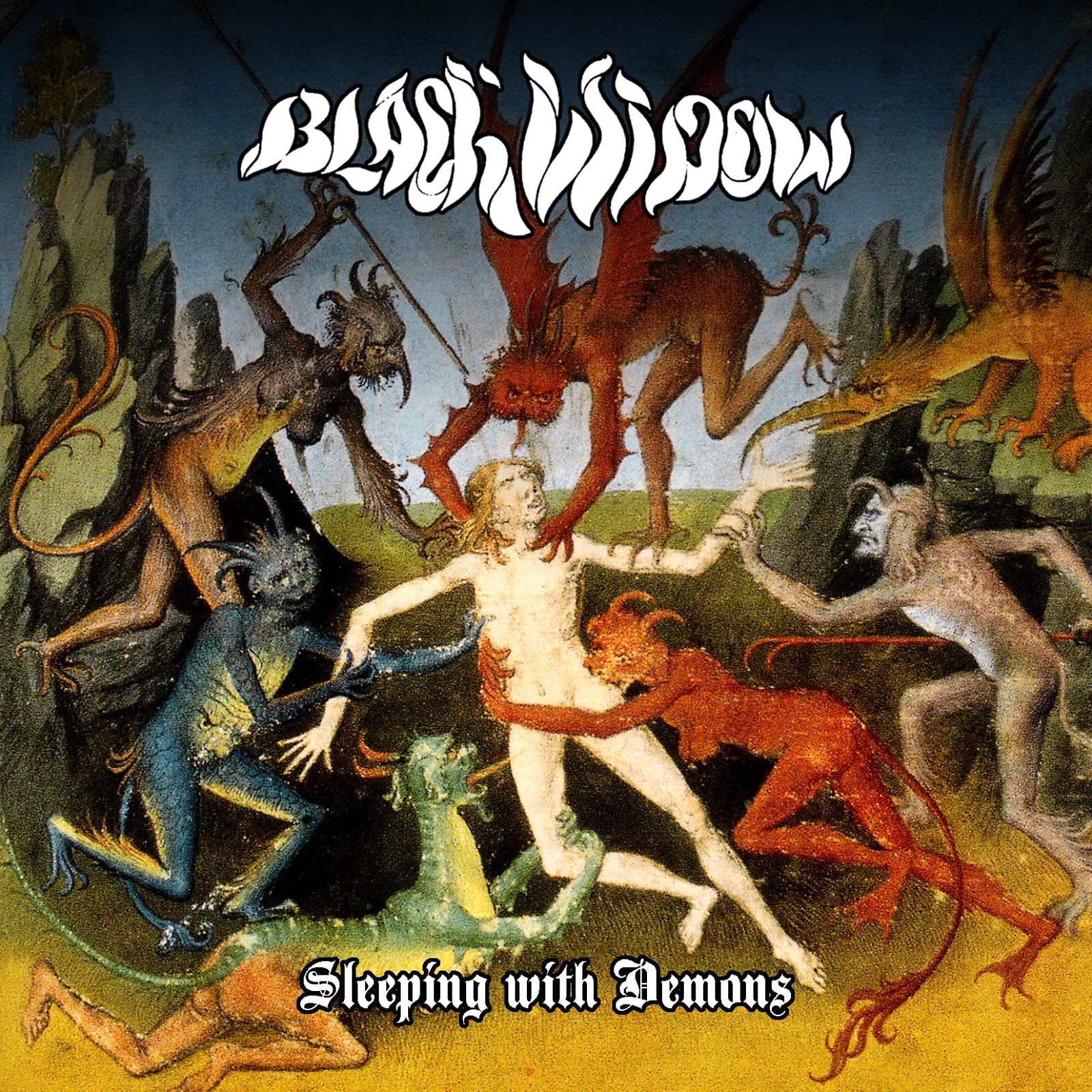
Black Widow - Sleeping With Demons 2012

Leicester, England-based Black Widow formed in 1969 from the ashes of blue-eyed soul band Pesky Gee! Jim Gannon(vocals, guitar, vibraphone), Kip Trevor (vocals, guitar, harmonica), Zoot Taylor (keyboards), Clive Jones(woodwinds), Bob Bond (bass), and Clive Box (drums) played dark, allegedly satanically inspired rock along the lines of Black Sabbath, and gained plenty of attention and controversy for their theatrical live sets. Black Widow made the U.K. Top 40 with their 1970 debut album, Sacrifice. Despite, or perhaps because of, the focus on their occult trappings, they moved away from their dark roots with their 1971 self-titled album and continued this trend with the following year's Black Widow III. By this time, however, lack of critical and label support, plus many lineup changes, caused the group to falter. Late in 1972, after losing their deal with CBS Records, Black Widow recorded Return to the Sabbat, a self-produced set that did not see the light of day until 1999, when it was released by Blueprint Records. A tribute album, Come to the Sabbat, appeared later that year as well. AMG.

listen here

Rob Wasserman - Trios 1994

Bassist extraordinare picks up from the previous duets release with this set of trios. Most of these songs were written for this project, some even improvised on the spot as in the case of the Edie BrickellWassermanGarcia cuts. Elvis Costello, along with Marc Ribot, are great. There are some bass instrumentals but the best is "Fantasy Is Reality" written by Sam Philips and Brian Wilson and sung by his daughter Carnie. AMG.

listen here

Brother Ah & The Sounds of Awareness - Key to Nowhere 2016

After the IKEF reissues of the first two albums by Brother Ah (aka Robert Northern, ex-Sun Ra French horn player, flutist, music therapist, and educator), the extraordinary Sound Awareness, originally on Strata East and notable for an extended rap from none other than Max Roach, and 1975's Move Ever Onward, comes Key to Nowhere, recorded in 1983. Like Move Ever Onward, this was originally issued on Ah's own Divine Records imprint and features Ah on flute, horn, harmonica, nayamka, and shell horn leading an octet including Jeff Majors on harp and thumb piano and Natasha Hassam Youssef on vocals. Majors' harp work inevitably invokes the spirit of Alice Coltrane and his mbira flourishes on the pentatonic 12/8 jam "Sekou" recall Earth, Wind & Fire's Maurice White, and there's a good splash of Ramsey Lewis' "Wade in the Water" on "Hanifah," but the album wears its heart on its sleeve well and never comes across as maudlin, the odd ham-fisted lyric notwithstanding. AMG.

listen here