segunda-feira, 1 de agosto de 2016

Henry's Funeral Shoe - Donkey Jacket 2011

Playing bluesy hard rock with plenty of attitude, a classic rocker's appreciation of history, and a punk's sense of concision, Henry's Funeral Shoe is a power duo from South Wales consisting of Aled Clifford on guitar and vocals, and his younger brother Brennig Clifford on drums. Aled's early musical inspiration came from his father's collection of LPs, as the youngster began checking out the work of iconic rock bands such as the Beatles, the Who, and Creedence Clearwater Revival, as well as a variety of blues acts ranging from Robert Johnson to Peter Green. Aled took up the guitar, mentored by musician Ned Edwards (best known for his work with Van Morrison), and he began playing solo acoustic shows, focusing on blues-oriented material. After several unsatisfying experiences playing with bands, Aled chose to return to solo work when he was asked by his brother Brennig to get together and jam. Brennig, ten years younger thanAled, was inspired to take up drumming by the fiery stickwork of Keith Moon, and the brothers soon found that Aled's forceful, blues-rock style and Brennig's frantic percussion made for an effective combination. In 2008, the two began performing as Henry's Funeral Shoe (the name coming from an unpublished short story written by Aled), and while several bassists were auditioned to round out the group, the Clifford brothers felt that they worked well enough as a two-piece to do without. The group came to the attention of Alive Natural Sound Records, an American label that's home to several contemporary punk-blues acts, and in 2009, the label released Henry's Funeral Shoe's first album,Everything's for Sale. After extensive touring in Europe and the U.K., the duo returned in 2011 with their second LP, Donkey Jacket, featuring guest appearances by Justin Beynon of Broken Vinyl Clubon keyboards, Pete Hurley (a former member of Welsh hard rockers Lone Star) on bass, and Aled's one-time teacher Ned Edwards on harmonica. AMG.

listen here

Elf Power - A Dream in Sound 1999

The aptly titled A Dream in Sound is Elf Power's creative breakthrough -- inventively produced by the great Dave Fridmann, the record is a great leap forward from the previous When the Red King Comes, boasting a bright, majestic sheen (the richest to grace an Elephant 6 release to date) that illuminates the striking pop melodies once buried below the group's fuzz-drenched surface. Although song titles like "High Atop the Silver Branches" and "Simon (The Bird with the Candy Bar Head)" serve notice thatthe Elves' psychedelic tendencies are still in full bloom, there's a new emotional complexity behind the songs as well -- Andrew Rieger's high, plaintive vocals lend a strange poignancy to his surreal narratives, and tracks like the lovely "Jane" possess genuine sweetness and warmth. A major addition to the E6 canon, A Dream in Sound pushes Elf Power to the label's front lines alongside Olivia Tremor Control and Neutral Milk Hotel -- lofty company indeed. AMG.

listen here

Bobby Beausoleil & The Freedom Orchestra - Lucifer Rising 2004

Everyone reviewing this record seems to get hung up on the fact that Bobby BeauSoleil is an inmate, serving a life sentence for murder, who had ties with the Charles Manson cult, and who recorded and produced this psychedelic prog rock soundtrack, in prison, for a film extolling the virtues of Lucifer. If these are the only things that lend credence to this album, someone forgot to actually listen to it. Lucifer Rising is a beautifully realized work, no matter what the circumstances were surrounding its coming to be. BeauSoleil is a talented arranger and a fine guitarist, with a knack for guerilla recording that most D.I.Y. engineers, on the outside, would be envious of. Layers of guitar, processed through handmade effects units, and hot-rodded junks hop synthesizers issuing indescribable tones arc and dive throughout BeauSoleil's spacious soundscapes. The sound stage is wide and horizon-less, with dark-toned movements rising up from stygian depths and then ascending heavenward with gorgeous chordal fusillades. For a compact introduction to BeauSoleil's epode-like songsmithing, "Part III" offers a strata-revealing overview. Moving from Piper at the Gates of Dawn-era Floyd motifs, the song evolves into an intricate and vacillating progression reminiscent of Air's "Don't Be Light" with all of the dazzling chordal movement, but none of the pomp. Floyd and Air comparisons aside, the most accurate description of BeauSoleil's trajectory would be psych-prog by way of Claude Debussy, and hard rock as it may have been envisioned by Ennio Morricone. Lucifer Rising is far too beautiful to be labeled as hard rock, far too focused to be written off as meandering prog, and too full of merit to be judged solely on the heteroclite life of its composer. AMG.

listen here

Holly Golightly & The Brokeoffs - You Can't Buy A Gun When You're Crying 2007

Holly Golightly exists in that rarefied class of performers who are regarded as legends of prolific measure, but whose adoration is restricted to a small, devoted following. The fact that her followers (and collaborators) include the likes of Jack White and Dan Melchior doesn't hurt matters. Her recent song "There Is an End," a collaboration with Cincinnati, OH's the Greenhornes, was even included in the film Broken Flowers. However, being delightfully oblivious to the mainstream, Golightly has never altered her style or sound to appeal to a larger audience. In fact, she's stripped her sound down from her comparatively lush approximations of '60s girl group revelry and come up with a perfectly primitive bunch of songs for this 2007 release, You Can't Buy a Gun When You're Crying. Billed as the debut effort of Holly Golightly and the Brokeoffs, it's worth noting that, despite the pluralistic moniker, "the Brokeoffs" is actually a somewhat mysterious guy simply called Lawyer Dave, a one-man-band from Texas. The album is a barebones collections of duets culled from an eerie Americana backwater tradition that suits Golightly like a glove. Though they come from seemingly different worlds, the two singers mesh well, with Golightly's soft warble playing against Lawyer Dave's slurring drawl. There are elements of the haunted harmonies of the Carter Family in the mix, as well as traces of lonesome Delta twang, and Golightly's own otherworldly sensibility. At its best, the album sounds like leftovers from the cutting room floor of Alan Lomax. Built around a simple mantra of, "Ain't nobody gonna love me like the devil do," repeated infinitely by Golightly in her quavering, slightly nasal, Victoria Williams-esque little girl voice, "Devil Do" is an understated highlight. "Got me drunk on whisky/Drunk on wind/The lord don't like it/But the devil don't mind," sings Lawyer Dave during the cheeky verse of the backporch stomper. Later in the album comes the turn of the screw with the altered reprise "Jesus Don't Love Me," and among the highlights is the aching balladry of "Just Around the Bend": "When you were planning and dreaming/Of how you would leave in the end/But you didn't see this coming/From just around the bend," sings Golightly coyly. The song is a steady waltz that builds an eerie, almost murder ballad-esque tension as it twirls along. Golightly's knack for turns of phrase and unique story angles harkens back to her early colleague, Billy Childish. Though now, perhaps more than on previous efforts, she seems to be coming into a bit more of her own personality. Just as it's difficult to listen Thee Headcoatees without feeling a little like you're listening to a play of some sort, it's difficult to listen to this album without getting the impression that Golightly's still sort of acting, playing the role of this archaic Appalachian songstress. Fortunately, the role becomes her. AMG.

listen here

sexta-feira, 24 de junho de 2016

Evan Parker & Joe McPhee - What If They Both Could Fly 2013

Evan Parker and Joe McPhee have played together in many different group settings over the years, but have recorded as a duo only once before, back in 2003. What/If/They Both Could Fly was recorded in the moment on-stage at the Konigsberg Jazz Festival in July of 2012. Parker plays tenor saxophone throughout, while McPhee plays both trumpet and soprano saxophone. The nearly 40-minute meeting is divided into three distinct pieces, two longer works over 18 and 13 minutes respectively, and the closer, a tad over six and a half. Rather than a confrontation, this concert is closer to an active conversation between two friends, who are very familiar with one another's "speaking" styles. Parker is content to explore a fairly narrow tonal range on the tenor, but he is far from short on ideas. His fits and starts punctuate, assert, investigate, and question and his wonderful multivalent use of circular breathing offers quick idiomatic moments. McPhee's playing on both instruments tends to a more lyrical side, as has been his wont since the 1960s. While smatterings of notes are common, they almost always exist in a give-and-take manner. Not call and response, exactly; more like assertion first, followed by elaboration, occasionally argument, and either resolve or retreat. What's most striking on opener "What" is that, after near symbiotic statements, Parker takes to poignant circular breathing solos three times. When McPhee responds, it is with elongated single notes, shifting ever so slightly in tone, leading Parker to follow in adding more textural dimension to the established dialogue. Speaking of texture, "If" commences as a study in breathy whispers through both tenor and soprano before it takes off. When it does, it is lively, strident, full of seeming debate, yet always focused. Parker takes more solo space, but it is McPhee's changes of direction that give the piece its weight. For fans of improvised music, What/If/They Both Could Fly has much to offer. For seasoned listeners, it will not likely reveal many hidden new doors, but it is enjoyable and engaging for its lively interplay, presented in a relaxed, open, and inquisitive fashion. AMG.

listen here
Gnonnan Sossou Pierre Kouassivi, known by the stage name Gnonnas Pedro was a singer and musician from Lokossa, Benin. He is perhaps best known as the lead singer of Africando between 1995 and his death in 2004, but had been well known in his home country of Benin and beyond since the 1960s.

Pedro led his own bands Pedro y Sus Panchos, later reforming as Gnonnas Pedro and his Dadjes Band, before joining the long-lived Orchestre Poly-rythmo de Cotonou.

As a singer, songwriter, instrumentalist, and dancer, Pedro embraced many styles of music including highlife and juju. Pedro is credited with updating the traditional Agbadja style of his home region, creating Modern Agbadja. He sang in many different languages, including Minad, Adja, Yoruba, French, English, and Spanish.

Pedro produced the song Feso Jaiye, which became a hit and was performed by many bands at the 2nd All-Africa Games in 1973.

listen here

domingo, 19 de junho de 2016

Johnny Jenkins - Blessed Blues 1996

Twenty-six years after releasing Ton Ton Macoute, Johnny Jenkins -- a local legend around Macon, Georgia -- released his second album, Blessed Blues. Featuring a selection of new songs, classic covers, and a new version of his 1962 hit "Miss Thing" (also known as "Love Twist"), Blessed Blues gives a good idea why Jenkins is revered in his homestate. His playing is swampy, dirty and impassioned -- it is soaked in the sounds of the deep south. Blessed Blues doesn't clean up his sound at all, preferring to showcase Jenkins in all of his gritty glory. On the whole, it isn't quite as searing asTon Ton Macoute -- after all, that featured support by Duane Allman -- but Blessed Blues proves that good things are worth waiting for. AMG.

listen here

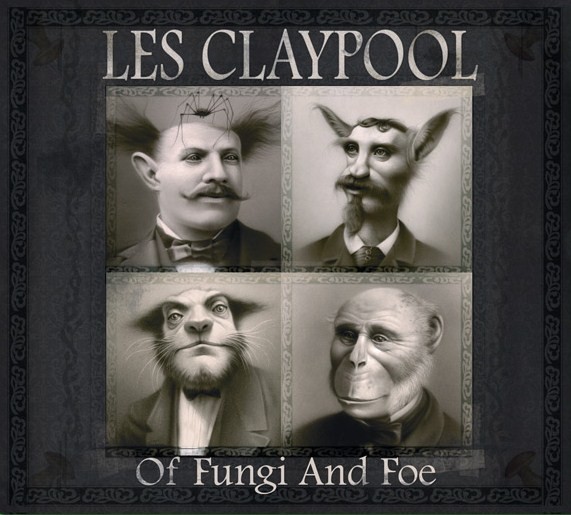
Les Claypool - Of Fungi and Foe 2009

As what would seem like music made purely for the stoner crowd -- particularly, for the folks partial to psychedelic 'shrooms -- Les Claypool's Of Fungi and Foe is a demented, cartoonish ode to, you guessed it, mushrooms. But it's not what you might think. Claypool didn't make this record as a cheap ploy to win over Phish's massive hippie fan base after learning of their endless devotion to drug-friendly music while touring with Trey Anastasio in Oysterhead. Even though Phishheads (and Weenheads) will probably find the goofy, cartoonish rollick herein worth visiting, Claypool had other motives behind the drug-friendly theme. The majority of the songs were originally written to be used as a soundtrack for Mushroom Men: The Spore Wars, a video game about mushrooms brought to life after a radioactive meteor, and Pig Hunt, a horror movie about a giant rabid black boar that guards a marijuana field. As well as bouncy bong songs with lyrics like "Now Errol's a smart boy who delivered big weed/Says that he could get you all that you may ever need," there are also some departures. "Red State Girl" drifts off topic as a Democratic satire about a girl who wants to grow up to be like Sarah Palin, and "What Would Sir George Martin Do" ponders how the Beatles producer would go about catching a cab. It's typical Les Claypool tomfoolery, all based around his past couple years making minimalistic jams -- beating bongos, bowing the occasional cello, playing a xylophone, and of course bassing it up through all sorts of weird-sounding envelope filters. Even though he's not billed with the Frog Brigade, it's not entirely a solo affair. Six other musicians make appearances, including Eugene Hütz, frontman of the Gypsy punks Gogol Bordello, who stops in for a jam on "Bite Out of Life." AMG.

listen here

Nicholas Payton - Gumbo Nouveau 1995

Only 22 at the time of this CD, Nicholas Payton had already quickly developed into a major trumpeter. Possessing a fat tone that is sometimes reminiscent of Freddie Hubbard, by the mid-'90s Payton had become New Orleans' latest significant contribution to jazz. On his second Verve release, Paytoninterprets and modernizes ten songs associated with his hometown and/or Louis Armstrong. Fortunately, Payton generally retains the flavor and joy of the original versions, even while he transforms much of the music into hard bop. To cite a few examples, "Whoopin' Blues" has parade rhythms, send-offs worthy of Lionel Hampton, and boppish solos, "Way Down Yonder in New Orleans" is taken as a slow and lightly swinging ballad, and "I Gotta Right to Sing the Blues" is turned into a jazz waltz. "Li'l Liza Jane" becomes a largely unrecognizable hard bop romp and this version of "When the Saints Go Marching In" is a bit melancholy, but "Wild Man Blues" is a real tour de force for the trumpeter and the duet between Payton and pianist Anthony Wonsey on "Weather Bird" has the leader liberally quoting from Louis Armstrong's classic version. Throughout the date, Payton is the lead voice, pianistWonsey is the main supporting player, and there are occasional solos from altoist Jesse Davis and tenor saxophonist Tim Warfield. New Orleans jazz purists may not care for all of the updating, but the overall results are fresh and quite likable. Recommended. AMG.

listen here

King Ubulu - Onweli Egwu Na Amu Ka Nma 1989

Chief Augustine Ojinji, better known to Nigerian music fans as "King Ubulu" and "Love A.U.," breathed his last in late 2004.

King Ubulu was born in 1949 in Amorji-Onicha in present-day Ndokwa Local Government Area, Delta State. Along with his fellow Ndokwa indigenes Charles Iwegbue and Rogana Ottah, he did much to advance the cause of Anioma (Western Igbo) highlife in the Nigerian music scene.?His generosity was such that he was given the honorifics Ochiligwe ("Majority Leader"), Elishi Egwu ("Music Leader") and Ofodile ("Mighty").

Ubulu trained as a shoemaker, but soon opened a record store in Amorji. Because of his skill with the traditional repertoire, he was often asked to sing at funerals, naming ceremonies and other important occasions. Together with Agu Risky and a number of other musicians, he formed the Ubulu International Band in the early 1970s. The group's first LP, Ukwuani Special, was released in 1976 to wide acclaim, followed by a number of other releases.?

In 1983 the Ubulu International Band of Nigeria recruited the late Charlie Boogie of Cameroun, who brought much animation to the group's stage show with his penchant for playing guitar and keyboards with his teeth.

In the 1986 album Onyebu Uwa Nishi, Ubulu warned against those who would try to copy his musical technique, as it came from water (presumably it was as transparent, flowing and natural as that substance).? - John Beadle

listen here

Jennylee - Right On! 2015

When members of distinctive-sounding bands step out on their own, they risk sounding too much like their main projects, or trying too hard to sound different. Fortunately, Warpaint's Jenny Lee Lindberg -- billed here as jennylee -- strikes a good balance between familiar and unique on Right On!, a set of songs that puts the spotlight on various aspects of her music in an intimate setting. Working with co-producer Norm Block, her Warpaint bandmate Stella Mozgawa, and Dan Elkan (who has also collaborated with Broken Bells and Them Hills), Lindberg imbues the album with a late-night spareness full of spaces and silences that allow dreams and memories to bloom. While songs such as the folky closing track "real life" make the bones of her songwriting more apparent than they would be on a Warpaint album, Lindberg's signature haze is present throughout Right On! The winding psych of "blind" is earthier here than it would be with her other band, and sensuality is front and center on "he fresh" and "boom boom" in ways that sound raw and fresh. This direct, kinetic approach shines on more driven moments like "never"'s post-punk-pop and "riot," a teeth-bared rocker that rivals the density ofWarpaint's most intense tracks. As on her other project's music, Right On! is most intriguing whenLindberg swirls sounds and emotions into unexpected new forms. Her cooed threats on "bully" ("you'd better run away and get out of my face") and the anger bubbling just under the pretty surface of "offerings" are challenging, ambiguous, and deserving of close listening. Occasionally, Right On!'s stripped-down sonics are too restrained for their own good -- "white devil" doesn't have the fuel it needs to truly ignite -- but more often than not, the album offers a welcome glimpse of Lindberg on her own. AMG.

listen here

Orchestra Super Mazembe - Kaivaska 1982

With a varying line-up of between nine and 14 musicians, Mazembe (Zairois for earth movers) were one of the most popular Kenyan bands of the 80s, and for a brief while in the mid-80s enjoyed a cult following in Europe, following their signing by Virgin Records and the UK release of the album, Kaivaska. Although based in Kenya since the early 70s, the band’s personnel is wholly Zairean - it being one of several outfits that decided to leave the overcrowded Kinshasa scene in the late 70s to move to the greener East African markets of Kenya and Tanzania. Like fellow expatriates Orchestra Makassy, Mazembe have recorded their most popular material in Nairobi with British producer Norman Mighell. In 1984, they enjoyed a sizeable international hit with a cover version of Nguashi Timbo’s East African evergreen, ‘Shauri Yako’, which had been included on Kaivaska. A second UK album, Maloba D’Amor, repackaged some of the Kaivaska tracks - including ‘Shauri Yako’ - while new material included a curiously faithful reading of the old Buddy Holly hit ‘Words Of Love’ (the title track). AMG.

listen here

Nahko and Medicine for the People - On the Verge 2014

Nahko (Nahkohe Parayno), a sixth generation Apache/Mohawk with a Puerto Rican/Indian mother and a Filipino father, grew up with the family that adopted him in an Oregon suburb, and suffered some early childhood identity problems until he began to ground himself in music, taking up the piano at age six, and in his teens he gave piano lessons and directed musical productions for local schools. His talents landed him a seasonal production position in Denali, Alaska, and there, with the wilderness around him, he began to put all the musical, cultural, and philosophical pieces of his personal creative vision together. Seeing music as international, multi-generational, and multicultural, and as a redemptive and healing force, he joined with his backing group, Medicine for the People, anchored by horn player and Berklee School of Music graduate Max Ribner and percussionist Hope Medford. Together they began making what has been called "thump-hop," a percussion-heavy, rainbow-envisioned mix of styles and approaches that is at times as much spoken word as anything else, a sort of 21st century medicine show for the mind and soul. A debut album, Dark as Night, appeared in 2013, and debuted at number six on the Billboard Heatseekers album chart. Hoka, the group's sophomore studio album, arrived in 2016 via Side One Dummy. AMG.

listen here

quarta-feira, 15 de junho de 2016

Christian McBride - A Family Affair 1998

Hallelujah! Christian McBride is not one of those strait-laced, down-the-line neo-boppers after all. Here, the prodigiously talented young standup bassist proves that he is also an astoundingly gifted electric bassist, and that '70s-vintage funk and soul are every bit as close to his heart as '50s and '60s hard bop. On electric, McBride weaves inventive countermelodies around tenor sax Tim Warfield's lead lines, taking Jaco Pastorius' technique a step further in sheer speed and the ability to play really nasty funk patterns. The stylistic palette of the disc is much wider than anything McBride has done before as a leader, ranging from soul ballads (a lovely cover of Stevie Wonder's nearly forgotten "Summer Soft," Wonder-like vocals from Vesta on "...Or So You Thought") to powerful funk ("Brown Funk [For Ray]"), open-ended electric jazz-rock ("Wayne's World"), and yes, straight-ahead acoustic jazz grooving (on Sly Stone's "Family Affair"). Charles Craig excels on acoustic piano, Fender Rhodes, and Wurlitzer electric pianos; drummer Gregory Hutchinson fearlessly handles any stylistic curve balls that McBride throws at him; and guitarist Russell Malone and percussionist Munyungo Jackson turn up now and then. As produced by fellow polystylist George Duke, this is a most encouraging step out of the trap of lockstep bop for McBride. AMG.

listen here