domingo, 31 de agosto de 2014

Omar Sosa - Isolanos 2008

Multi-instrumentalist Omar Sosa was born on April 10, 1965, in Camaguey, Cuba. At the age of five, Sosa began studying music at the Escuela Provincial de Musica in Camaguey, which led to his intense study of drums and percussion at two other schools during the late '70s/early '80s: Cuba's Escuela Nacional de Musica and Instituto Superior de Arte.Sosa then began to teach percussion to children before he created the group Tributo in 1986, for which Sosa penned and oversaw the material for two of their albums, and toured. This was followed up by Sosa's work with Cuban vocalistVicente Feliú (1988's Arteporética), the group XL Talla Extrawith Cuban vocalist Xiomara Laugart, the jazz fusion outfit Entrenoz, the Afro-Ecuadorian band Koral y Esmeralda, and playing keyboards in the band Koan Fussion. And in the late '90s, Sosa began issuing solo albums: the 1996 solo piano showcase Omar Omar, 1997's ensemble-based Free Roots, 1998's Inside, 1999's Spirit of Roots and Bembon, and 2000's Prietos. In addition, Sosa has also produced recordings for Ricardo Williams, Leo Mass, and Vino y Miel. Two years later, Sosaissued the eccentric jazz album Sentir. It was later nominated for a Latin Grammy Award for Best Latin Jazz Album in fall 2002. AMG.

listen here

Buy @ Amazon: USA - FR - UK

Souad Massi - Mesk Elil 2006

Any written dispatch on Souad Massi is apt to turn up the words "Algerian singer/songwriter" before the reader can grasp that cultural strings have little to do with her appeal. That's unfair, given the lengths to which the self-serious but lithe-voiced performer has gone to establish herself as a citizen of the world.
Born into a poor Muslim household in 1972, Massi spent her formative years in Bab el-Oued, a suburb of Algiers, as one of seven siblings. She absorbed a love of music from her piano-playing brother who, despite protestations from their father, convinced their less traditional-minded mother that the guitar lessons she yearned for were worth the investment. By 1992, with Algeria in a brutal civil war and a 7 p.m. curfew in place nationwide, Massi's dreams of mastering her instrument seemed dashed; attending lessons was all but impossible, especially given her sex and Muslim-unfriendly jeans-and-sneakers style.
But life as a semi-shut-in had its advantages for Massi. Instead of stifling her creative instincts, it magnified them. The artist, like many introspective prisoners, dug deep, and through careful attention to American cowboy movies -- The Good, the Bad, and the Ugly, for example -- Massi amassed a collection of favorite sounds. Soundtrack-derived country and folk songs delivered her to the radio dial, where she sought out American roots music. And strumming along eventually turned her proficient enough to join her first band, a flamenco outfit with which she quickly grew bored.
Abandoning that watered-down group would lead to a life-altering musical choice: Massi signed on to front Atakor, a heavy-rock band with political leanings. Her seven years with Atakor earned her a troublemaker's reputation in fundamentalist Algeria, where she quickly became the target of spitting and general scorn. And as the band called more attention to itself with what some considered inflammatory lyrics, danger encroached -- Atakor's equipment was routinely snatched at false road blocks, and Massi, who had disguised herself by cutting off her hair and camouflaging her body with boys' clothes, nevertheless became the target of death threats after the release of a late-'90s Atakor cassette.
By 2000, Massi fled to Paris. Though she took part in that city's "Femmes d'Algerie" concert as a new arrival, she was contemplating a life outside music at the time; a quick-acting Island Records executive who extended a contract changed her mind. In 2001, Massi's solo debut, Raoui, was released on the U.K.'s Wrasse Records label. Like its follow-up, 2003's Deb, also on Wrasse, it concerned itself with the personal rather than the political. Melancholy ballads sung in Arabic, French, and English typically melted into rock, folk, flamenco, and classical backdrops. Those sensitive-minded reflections on love and loss, set to achingly pretty sounds that stray far from North Africa's traditional, pounding rai rhythms, also light up Mesk Elil (Wrasse),Massi's 2006 release. If Massi's personal transformation and her mastery of genre-jumbling is impressive, her voice is no less so on all three of her discs: the flavors of Merita HaliliKarla Bonoff, and Basia that float through are as universally appealing as the story of her struggle to secure artistic freedom
. AMG.


listen here

Buy @ Amazon: USA - FR - UK

Nené - Ponto dos Músicos 1984

One of Brazil's most influential drummers/percussionists, Nene has participated in a variety of projects. In addition to leading his own group, Nene has collaborated with jazz musicians from around the globe. A member of Hermeto Pascoal's band from 1978 to 1980 and Egberto Gismonti's band in 1980, Nene has performed and/or recorded with a lengthy list of artists, including Milton Nascimento, Cesar Camargo Mariano, Elis ReginaEdu LoboClaude NougaroCharlie HadenBob MosesSteve Lacy, and Richard Galiano. His book, Brazilian Rhythms, published by Zurfluh Editions in Paris in 1988, remains the authoritative source on the subject.
A native of the southern Brazilian city of Porto Alegre, Nene showed musical talent at a very young age. Although he began playing the accordion at the age of 12, he soon turned his attention to the drums. By his 15th birthday, he had launched his musical career. Within four years, he had advanced to a spot in Pascoal's band. After continuing his apprenticeship with Gismonti, Nenes formed his own band in 1980, releasing his debut album, Bugre, two years later.
Moving temporarily to France in 1983, Nenes found himself in demand as a session player. In addition to performing with Claude Naugaro, he formed the Nene Band with three Brazilians and two Danes. Over the next decade, he divided his time between his homes in France and Brazil. He remained in neither place for long, touring with a superband featuring GismontiKenny Wheeler, and Bob Mosesin 1985. Although he returned to Brazil in 1986, touring and recording with Pau Brazil, he returned to France the following year and became the resident composer for the Danish National Jazz Orchestra. A tour with GismontiCharlie Haden, and Michel Portal in 1989 was followed by a tour of Japan withTakashi Kako, performances with the Steve Lacy Group, and a tour of Brazil with Pau Brazil the following year. Nene's skills as a composer were demonstrated by a full-length production, Opera Dos Quinhentos Anos, featuring the libretto of Naum Alves de Souza, that was presented at the Teatro Municiple in Sao Paulo in 1992. He continued to periodically renew his collaboration with Pascoal. In 1993, he performed 45 concerts in Europe with a trio that also featured Pascoal and Arismar Do Espirito Santo. The following year, he toured Europe with Pascoal and accordion player Richard Galliano. As a teacher and guest lecturer, Nenes has shared his knowledge at the Festival de Musica de Campos de Jordao and the 27th Festival de Inverno de Ouro Preto. In 1997, he performed during a second seminar of Brazilian rhythms in Belo Horizonte. AMG.

listen here

Buy @ Amazon: USA - FR - UK

segunda-feira, 25 de agosto de 2014

V.A. - Strangely Strange But Oddly Normal: An Island Anthology 1967-1972 3cd 2009

Most casual onlookers don't remember it today, but there was a time when Island Records was well known as the home of numerous varieties of music beyond classic reggae and the 1980s work of U2. In fact, from 1967 until the early/mid-'70s, Island was one of the major outlets for progressive and art rock bands in England. The label didn't have much of a presence in the United States until the second half of the 1970s, and many of the groups that it had under contract only released their work through Island in England, with major acts such as Jethro TullKing Crimson, and Emerson, Lake & Palmerhaving separate contractual relationships with Warner/Reprise and Atlantic in the United States. But Island's U.K. roster of prog rock acts was impressive, as you're reminded by just about every minute of this three-CD, 48-track box, which encompasses everything from the widely familiar (Traffic's "Paper Sun" and "Feelin' Alright," Jethro Tull's "A Song for Jeffrey" and "A New Day Yesterday") to culty weirdness (Wynder K. Frog's "Harpsichord Shuffle") and genuinely experimental acts such as White Noise, and strange B-sides (King Crimson's "Groon"). The obscurities flow fast and thick throughout, including the Mick Moody guitar showcase "Pearly Queen" as recorded by Tramline (many years before Moody would find fame and fortune with Whitesnake), and Quintessence's "Giants" and "Notting Hill Gate," the latter a classic British hippie anthem. The emphasis is on singles where they were relevant, although notable album cuts are also present -- everything from one-off singles likeKing Crimson's "Catfood" (by a version of the band that scarcely existed for a month) to "A Sailor's Life" by Fairport Convention, clocking in at 11 minutes plus, which reappeared in their repertory for decades. The range of sounds is also wonderfully diverse, from the progressive folk axis of John Martyn/Fairport/Sandy Denny/Nick Drake/Incredible String Band/Amazing Blondel through arty rockers like ELP and McDonald & Giles, to the bluesy hard rock focus of Tramline and Free, as well as acts like Tull that fall in between them, and horn bands like Alan Bown that fall outside of any of them. The sound is excellent throughout, the annotation is extremely thorough, and the packaging is well designed and easy to use (and this reviewer loves the fact that the box and sleeves re-create the color scheme of the old Island logo). What's more, the cost has been held to the midline range (equal to roughly 12 dollars a disc on the American side of the Atlantic), making this nearly four-hour-long release not only attractive to longtime enthusiasts of this sort of music, but an ideal vehicle for neophyte listeners to experiment with and discover the genre and the history, and the wealth of lesser-known and downright obscure bands represented here alongside the famous. AMG.

listen here

Buy @ Amazon: USA - FR - UK

Ravi Shankar - Tana Mana 1987

On his first release for Private Music, Ravi Shankar combined the traditional instruments of Indian music (sitar, sarod, tabla, etc.) with synthesizers and heavy sampling keyboard usage. Surprisingly enough, the combination works out for the best on the majority of the tracks. The reverberant quality of the sitar combines rather well with the chosen electronic accompaniments to form a set of coherent songs, unlike many other such attempted combinations of traditional instruments and technology. The sitar playing is, as usual, superb -- who would expect anything else to come from the legend himself (and/or his associate Shubho Shankar). With an extra sarod thrown in, a small front line of synthesizers, and Shankar's friend George Harrison assisting on the autoharp, the pile of musicality that forms allows an unexpectedly coherent, clear, and relatively focused piece of music to emerge. There are no specific highlights to speak of on this album, as all of the tracks are equal, and the level at which they are equal is rather high. The only real gripe to be had with the album is the lack of straight Indian classical playing by Shankar, though with his multitude of other albums, that can be forgiven. AMG. 

listen here

Buy @ Amazon: USA - FR - UK

Hermeto Pascoal - Festa dos Deuses 1992

A self-taught musician, Hermeto Pascoal ascended from his humble upcountry origins to an international acknowledgment still unfair to his musical stature. Developing his ears from an early age at his grandfather's blacksmith shop, Pascoal used to pick up pieces of iron and hit them, trying to create music (not to emulate the harmonics of his father's eight-bass button accordion, as has been spread). This led to an unusual approach to music, where the tones themselves give a stronger conducting motif than chord connection, scales, or modes. His understanding of music as a vital force, emanating organically from everything in Earth, is reminiscent of Kepler's music of the spheres and conducted to eccentric performances and recordings with pigs, kettles, and anything at hand. He has also developed the Sound of the Aura concept, in which music is developed out of people's speech, traffic noise, and out of every possible source of sound. That didn't impede him from conquering the admiration of world-class musicians such as Miles Davis, for whom he recorded as instrumentalist and composer. John McLaughlinDuke PearsonGil Evans, Berlin Symphony, Copenhagen Symphony, and many others played and recorded his compositions. He also recorded with Ron CarterAlphonso Johnson, Tom Jobim, Cal Tjader, and several others. As a sideman, he recorded with Brazilians Aquilo del NissoLuiz Avellar, Maria Bethânia, Fagner, Galo PretoEduardo Gudin,JoyceEdu LoboElis Regina (including a live concert recorded at the Montreux Jazz Fest), Walter SantosMauro SeniseRobertinho Silva, Sivuca, Marcio Montarroyos, Taiguara, Sebastião Tapajós, and Geraldo Vandré, to name a few. Down Beat's Howard Mandel, wrote about him "as pan-global a leader as Sun Ra and as surefooted an individualist as Rahsaan Roland Kirk."
His father used to animate parties with an eight-bass button accordion. Beginning to play at local parties at 11, in three months' time, Pascoal advanced so much that he took his father's place because he became ashamed to play together with him. In 1950, his family moved to the capital Recife PE, and he debuted at radio stations in that city and around. In 1958, he moved to Rio, working with the Regional de Pernambuco do Pandeiro, Fafá Lemos Group, and Orquestra do Copinha. In 1961, he moved to São Paulo, playing in several nightclubs there. Already playing brass and wood instruments, he formed the group Som Quatro with Papudinho (trumpet), Dilsom (drums), and Azeitona (contrabaixo). With Sivuca, he had an accordion trio called O Mundo em Chamas. In 1964, he began a fertile association with Brazilian percussionistAirto Moreira, joining his Sambrasa Trio (which also had Humberto Clayber on the double bass). His first recording was accompanying singer Walter Santos' LP Caminho in 1965, soon following the historical album No Fino da Bossa, Vol. 3, on which he backed Elis Regina on one track. The album was recorded in 1966 but was issued in 1994. Moreira was then in a band called Trio Novo which had guitarist Heraldo do Monte and bassist Teo de Barros; Pascoal joined them the next year and the group changed its name to Quarteto Novo. The first proponents of a Northeastern sound based on baião mixed with jazz improvisations, the group would be highly influential despite having recorded just one album, Quarteto Novo (Odeon, 1967). The album had Pascoal's first recorded composition, "O Ovo." In October of that year, the group accompanied Edu Lobo on "Ponteio" (Lobo/Capinam), the winning composition at TV Record's III FMPB (III Brazilian Popular Music Festival). In 1968, Pascoaltoured France. In 1970, he was invited by Miles Davis to record with him on the live album Live Evil. Davis also selected three of Pascoal's compositions for that album: "Little Church," "Nem Um Talvez," and "Selim." In fact, he selected 11 songs of Pascoal's material, but Pascoal wanted to release his solo album and let go only those two. As Miles had a habit of taking credit for tunes written by his groups' members, both were erroneously published under his name. Pascoal credits that to producer's tactics, not to Miles'. Pascoal's first solo LP, Hermeto (Cobblestone), was recorded in 1971 in New York and was produced by Ron Carter and Flora Purim. In that same year he, and Carter recorded another LP, with Pascoal's "O Gaio da Roseira," awarded as one of the best of the year by English critics.
In 1973, he toured through the U.S. and Mexico, recording in Brazil A Música Livre de Hermeto. By the Association of Critics of São Paulo (APCA), he was awarded as Best Soloist and, in the next year, Best Arranger. He toured the U.S. again in 1974 and had his song "Porco na Festa" awarded as Best Arrangement at the Globo Network's Festival Abertura. Recorded in 1976 with Sérgio Mendes and Brazil '77, he recording two more albums for Mendes in that period. His LP, Slaves Mass, released in 1977, also had Carter. In 1978, he recorded Zabumbê-Bum-Á. Since then, he has recorded 12 solo albums. His live performance at the 1979 Montreux Jazz Festival was recorded on a double LP and released through Warner: Hermeto Pascoal ao Vivo. In 1996, he was awarded with the Prêmio Sharp as Best Arranger for the Duo Fel CD Kids of Brazil. In the same year, he received the Prêmio Ary Barroso. His recordings as a sideman add to over 79 albums. In April 2000, Pascoal toured again through the U.S. and the Boston Globe, in a recent review of one of his American performances, commented: "With equal parts virtuosity and eccentricity, Pascoal's sextet gave the rare example of a band that actually earned its standing ovation." AMG.

listen here

Buy @ Amazon: USA - FR - UK

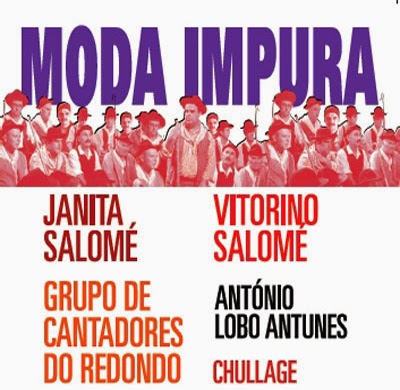
Janita Salomé e Vitorino Salomé - Moda Impura 2011

This is a Janita Salomé project, known as the most defender of the "cante alentejano" a special music style from Alentejo, Portugal. It's a rich music style that has inspiration in the several portuguese origins where you can listen an arabic touch. Give it a try.

listen here

Buy @ Amazon: USA - FR - UK

John Campbell - One Believer 1991

The Elektra debut by the late bluesman John Campbell is a curious affair in more than one respect-despite it's obvious excellence and original voice. The first is that he was signed at all. Clearly in 1990 when Campbell signed his deal, record company executives were still interested inn finding new and original talent and developing them over a period of time. One Believer was outside of virtually every trend on major labels and in pop at the time. Other than Chris Whitley's Living with the Law, it was the only roots record issued on a major label in 1991. The other thing is that One Believer is an oddity even for Campbell. It's a deeply atmospheric record full of subtle shimmering organs and warm guitar textures that accent the dreamy spooky side of the blues more than the crunchy stomp and roll that Campbell was known for in the clubs -- and displayed on his follow-up Howlin' Mercy. Tracks like "Angel of Sorrow," "World of Trouble," and "Wild Streak" offer shimmering ambient textures from which the blues emanate from the ether, tonally and melodically challenging all acceptable notions of what Texas blues should sound like -- but then, Mr. Campbell was living and working in New York and his music was certainly influenced by that late-night environment. These are beautiful songs, tempered in shadow and restraint while baring their teeth at all the right moments. Other places the roadhouse magic comes out of the closet as on "Couldn't Do Nothin'," "Devil In My Closet," and "Person to Person. On "Voodoo Edge," the slowhand blues meets a crisscross New Orleans second-line backbeat a la Dr. John and comes up with chunky honky-tonk piano and shakers to give the piece an "I Walk on Gilded Splinters feel, extending Campbell's sound over a deeper, darker shade of roots music. This in underlined by the album's last two tracks -- "Take Me Down" and the title track -- which are menacing in their conviction and creepy swampy in execution. This is a fine, fine debut that remains in print. AMG.

listen here

Buy @ Amazon: USA - FR - UK

Screamin' Jay Hawkins - Black Music For White People 1991

Screamin' Jay Hawkins was the most outrageous performer extant during rock's dawn. Prone to emerging out of coffins on-stage, a flaming skull named Henry his constant companion, Screamin' Jay was an insanely theatrical figure long before it was even remotely acceptable.
Hawkins' life story is almost as bizarre as his on-stage schtick. Originally inspired by the booming baritone of Paul RobesonHawkins was unable to break through as an opera singer. His boxing prowess was every bit as lethal as his vocal cords; many of his most hilarious tales revolve aroundJay beating the hell out of a musical rival.
Hawkins caught his first musical break in 1951 as pianist/valet to veteran jazz guitarist Tiny Grimes. He debuted on wax for Gotham the following year with "Why Did You Waste My Time," backed byGrimes & His Rockin' Highlanders (they donned kilts and tam o' shanters on-stage). Singles for Timely ("Baptize Me in Wine") and Mercury's Wing subsidiary (1955's otherworldly "[She Put The] Wamee [On Me]," a harbinger of things to come) preceded Hawkins' immortal 1956 rendering of "I Put a Spell on You" for Columbia's OKeh imprint.
Hawkins originally envisioned the tune as a refined ballad. After he and his New York session aces (notably guitarist Mickey Baker and saxist Sam "The Man" Taylor) had imbibed to the point of no return, Hawkins screamed, grunted, and gurgled his way through the tune with utter drunken abandon. A resultant success despite the protests of uptight suits-in-power, "I Put a Spell on You" becameScreamin' Jay's biggest seller ("Little Demon," its rocking flip, is a minor classic itself).
Hawkins cut several amazing 1957-1958 follow-ups in the same crazed vein -- "Hong Kong," a surreal "Yellow Coat," the Jerry Leiber/Mike Stoller-penned "Alligator Wine" -- but none of them clicked the way "Spell" had. DJ Alan Freed convinced Screamin' Jay that popping out of a coffin might be a show-stopping gimmick by handing him a $300 bonus (long after Freed's demise, Screamin' Jay Hawkinswas still benefiting from his crass brainstorm).
Hawkins' next truly inspired waxing came in 1969 when he was contracted to Philips Records (where he made two albums). His gross "Constipation Blues" wouldn't garner much airplay, but remained an integral part of his legacy for quite a while.
The cinema was a beneficiary of Screamin' Jay's larger-than-life persona in later years. His featured roles in Mystery Train and A Rage in Harlem made Hawkins a familiar visage to youngsters who never even heard "I Put a Spell on You." He died February 12, 2000 following surgery to treat an aneurysm;Hawkins was 70. AMG.

listen here

Buy @ Amazon:  - USA -  FR - UK