quarta-feira, 27 de junho de 2012
King Crimson - Three of a Perfect Pair 1984
Upon its release in 1984, Three of a Perfect Pair caused some unrest among fans of King Crimson. Most of their audience felt that the band had made a conscious and obvious decision to try to break through to a more mainstream pop audience. But in hindsight, this is hardly the case; it sounds unlike anything that was out at the time. Like 1982's Beat, Three of a Perfect Pair doesn't quite meet the high standards set by 1981's Discipline, but does contain a few Crimson treats. The opening title track has an unrelenting groove that never seems to let up, while "Sleepless" starts off with Tony Levin laying down some funky bass until Adrian Belew's trademark paranoid vocals kick in and assure the listener that "it's alright to feel a little fear." Also included are the seven-minute instrumental soundscape "Industry," and the cautionary tale of a "Model Man." This would prove to be the new King Crimson's last release for nearly ten years; the group disbanded soon after as its members concentrated on solo careers and other projects, until a mid-'90s reunion brought them all back together. AMG. listen here
John Renbourn - The Enchanted Garden 1980
An unusually enchanting album, even for John Renbourn; The Enchanted Garden is a follow-up to the John Renbourn Group's 1977 A Maid in Bedlam, devoted to medieval and Renaissance dance and classical music, as well as folk material and Indian ragas. The opening "Pavane" and "Tourdion," not to mention the 18th century carol "The Truth from Above" -- all among the prettiest pieces with which Renbourn has been associated -- are the sort of material that Noah Greenberg and New York Pro Musica used to do for classical audiences in the late '50s, and there's a Rameau harpsichord piece transcribed for dulcimer here, as well. Not that they don't "folk out" in various sections of this record -- "The Plains of Waterloo," with Jacqui McShee's vocals, could almost have passed for a Pentangle track, and she turns in one of her best performances ever (rivaling Sandy Denny's best) on the eerie and haunting "The Maid on the Shore" and "A Bold Young Farmer" (in her own arrangement). The dazzling eight-minute finale, "Sidi Brahim," is arguably one of the finest meldings of Eastern and Western musical influences you'll ever hear, with a subtlety and developmental sophistication that would humble George Harrison and Co. John Molineux, who plays the mandolin and dulcimer as well as fiddle, succeeds fiddle player Sue Draheim in the band, which also includes Glen Tommy on snare drum, Tony Roberts on flutes and recorders, and Keshav Sathe on tabla and finger cymbals. AMG. listen here
Joe Strummer & The Mescaleros - Rock Art And the X-Ray Style 1999
It has taken Joe Strummer ten years to follow up on his first solo album, Earthquake Weather, with Rock Art and the X-Ray Style, and while the vocals and occasional moments in the music are identifiable as the work of a man who was once a singer, guitarist, and songwriter in the Clash, no one should purchase this album expecting to hear a direct extension of his old band. Strummer, who helped lead the Clash beyond punk rock to a variety of rhythmic styles, has only expanded his range since, and Rock Art and the X-Ray Style is an album of songs built on often exotic, funky beats, few of which rock very hard. Over those rhythm tracks, Strummer sings highly poetic, apparently freely associative lyrics whose meanings usually seem to be either private to him or just not literal. Unfortunately, the vocals are high in the mix and the musical tracks are subservient to the lyrics (which are printed in the booklet) so that one is left to ponder what Strummer is talking about. Coming back after a decade, even on an independent label, it might have been hoped that Strummer would return to action with a more accessible effort than Rock Art and the X-Ray Style, which is unlikely to re-establish him as a major force in popular music. AMG. listen here
Baba Zula - Gecekondu 2011
Founded in 1996, the band features founding members Levent Akman and Murat Ertel as well as Coşar Kamçı, who replaced original member Emre Onel in 2005. BaBa Zula added live drawing artist Ceren Oykut into the mix in 2004. She left the band in 2010. Her presence onstage had added an important visual aspect to BaBa Zula's live performances. Akman, Ertel, and Onel originally formed Baba Zula as a side project of now disbanded Anatolian rock group Zen.
In 2005 Baba Zula was exposed to a wider international audience when they were featured in a documentary, Crossing the Bridge by Fatih Akin, which took an in-depth look at Istanbul's contemporary and avant-garde music scene.
Musical style
Described as "Turkey’s most beloved alternative music purveyors"[3] Baba Zula create a unique psychedelic sound, combining Traditional Turkish instruments, electronica, reggae and dub. The core of their sound is the saz, a Turkish bouzouki like stringed instrument with a bright, high-pitched sound. AMG. listen here
In 2005 Baba Zula was exposed to a wider international audience when they were featured in a documentary, Crossing the Bridge by Fatih Akin, which took an in-depth look at Istanbul's contemporary and avant-garde music scene.
Musical style
Described as "Turkey’s most beloved alternative music purveyors"[3] Baba Zula create a unique psychedelic sound, combining Traditional Turkish instruments, electronica, reggae and dub. The core of their sound is the saz, a Turkish bouzouki like stringed instrument with a bright, high-pitched sound. AMG. listen here
quarta-feira, 20 de junho de 2012
Tippett Moholo Minafric Orchestra - Live 2008-09-02 Sant'Anna Arresi
For those who are familiar with Louis Moholo's "Viva la Black" from the 1990's (and who may have seen my posts of two albums by this group), I want to point out that this is a re-incarnation in a different size and shape, relaunched in 2004. The constant element is Louis Moholo himself. The new elements are Keith Tippett, who contributes a fair number of the compositions, Julie Tippetts, and the Minafric Orchestra led by the Italian trumpeter Pino Minafra.
As Owen, a frequent and competent commentator on all things Moholo, said, "So, it’s a different Viva la Black [...] for sure, but by no means is it a lesser Viva la Black." listen here
The Smashing Pumpkins - Oceania 2012
Following up on, and in many ways amending, much of the bombastic overcompensation of 2007's Zeitgeist, Smashing Pumpkins 2012 release Oceania is an exuberant, gloriously melodic, fluid return to form for Billy Corgan. While Zeitgeist certainly contained many of the elements that make for a classic Smashing Pumpkins release -- including slabs of distorted guitars, passionate vocals, and poetic lyrics, not to mention drummer Jimmy Chamberlin, who was the sole remaining original member besides Corgan and who subsequently left the band -- there was something cold and perhaps a bit too calculated about the production. Ultimately, Zeitgeist didn't do much to dissuade audiences that Corgan, undeniably the mastermind behind the best Pumpkins work, was now overvaluing his abilities in an attempt to recapture fans disillusioned by his various side projects. Thankfully, none of these concerns are applicable to Oceania. Ostensibly an "album within an album" of the greater 44-track Teargarden by Kaleidyscope concept project, Oceania works as a stand-alone album. Conceptual conceits aside, these are some of the most memorable and rousing songs Corgan has delivered since 1993's Siamese Dream, the album that Oceania most closely mirrors in tone and aesthetic. Which isn't to say that Corgan is treading old ground; on the contrary, there is something fresh and inspired about the songs on Oceania. Admittedly, kicking the album off with the heavy psychedelic acid rock groove of "Quasar" -- in which Corgan croons several EST-era-style affirmations including, "God right on! Krishna right on! Mark right on!" -- is a move that almost begs comparisons to Smashing Pumpkins' euphoria-inducing 1991 single "Siva." A similar sentiment comes to mind with the latter album rocker "The Chimera," a classic rock-sounding groover that sparkles with crisscross laser-beam guitar lines recalling the jewel-toned guitar heroics of Queen's Brian May. But these are welcome comparisons, born out of Corgan finally delivering a gorgeous and cohesive set of songs that balance some his more arch, cerebral inclinations with his generously romantic and sweepingly cinematic gift for revelatory guitar rock. Elsewhere, we get the soaring "Panopticon" and the minor-key, prog rock-inflected drama of "Violet Rays." However, Oceania is perhaps best represented by the euphoric mid-album ballad "Pinwheels." Starting with a repeated keyboard line and building to swells of acoustic and electric guitar before settling into one of the most swoon-worthy melodic anthems Corgan has ever written, "Pinwheels," much like the rest of Oceania, is a masterpiece of pop songcraft and rock production. As Corgan croons on the song's chorus, "Sister soul, lovers of the tune, sing!/I got you/I got you." On Oceania, the Smashing Pumpkins definitely have us. AMG. link removed
Marion Brown - Why Not 1968
Alto saxophonist Marion Brown was an underappreciated hero of the jazz avant-garde. Committed to discovering the far-flung reaches of improvisational expression, Brown nonetheless possessed a truly lyrical voice but was largely ignored in discussions of free jazz of the '60s and '70s. Brown came to New York from Atlanta in 1965. His first session was playing on John Coltrane's essential Ascension album. He made two records for the ESP label in 1965 and 1966 -- Marion Brown Quartet and Why Not? -- and also played on two Bill Dixon soundtracks. It wasn't until his defining Three for Shepp (including Grachan Moncur III and Kenny Burrell) on the Impulse! label in 1966 that critics took real notice. This set, lauded as one of the best recordings of that year, opened doors for Brown (temporarily) to tour. He didn't record for another two years because of extensive European engagements, and in 1968 issued Porto Novo (with Leo Smith) on the Black Lion label. In 1970, Brown recorded Afternoon of a Georgia Faun for the ECM label, his second classic. This date featured Anthony Braxton, Andrew Cyrille, Bennie Maupin, Jeanne Lee, and Chick Corea, among others. In 1973, he cut his second Impulse! session, Geechee Recollections, with Leo Smith. Brown registered at Wesleyan University in the mid-'70s, studying ethnic instruments and black fife-and-drum corps music and maintained a regular recording schedule. He also recorded with Gunter Hampel in the late '70s and '80s, as well as composer Harold Budd on his Pavilion of Dreams album (issued on Brian Eno's Obscure label), Steve Lacy in 1985, Mal Waldron in 1988, and many others. There are numerous duet and solo recordings that may or may not be sanctioned. Due to health problems, Brown didn't record after 1992. After the turn of the millennium he lived for a while at a New York nursing home before moving to an assisted living facility in Florida. Marion Brown died in October of 2010. AMG. listen here
Patti Smith - Banga 2012
In the eight years since Patti Smith's last studio effort of new, original material, Trampin', she's toured, assembled art installations, had her photographs collected for global exhibition, and written Just Kids, a National Book Award-winning memoir. On Banga, Smith marries together her various forms of literary expression with rock and pop in an iconic assemblage. Her collaborators are (mostly) familiar: guitarist Lenny Kaye, drummer Jay Dee Daugherty, bassist Tony Shanahan, guitarist Tom Verlaine, her children Jackson and Jessi, and guitarist Jack Petruzzelli. Italian band Casa del Vento and Johnny Depp also appear. The album is saturated with poetry, sung or spoken -- sometimes both. Its themes range from a non-didactic reflection on environmental crisis, the dominion of art as man's greatest gift to the divine -- as well as its own species -- homages, elegies, and love songs, all offered with authority and tenderness. Musically, the album is absent the dynamic, free-form chaos that marks her earlier recordings, but is better for it. This is true even when the band stretches to improvise forcefully on a theme by Sun Ra in the glorious "Tarkovsky (The Second Stop Is Jupiter)." This is not to say that Banga doesn't rock; it does, all over the place: in the aforementioned cut, in the dramatic "Fuji-San," and in the blistering title track (named for a dog in Mikhail Bulgakov's Master and Margarita). But there are the pop songs, too: the hooky "April's Fool" (a song about nomadic lovers that echoes the themes in Just Kids), the sweet ballad "This Is the Girl," for Amy Winehouse, and the elegant waltz "Maria" (for Maria Schneider). "Mosaic," driven by Daugherty's mandocello riff, is a lush, sensual rocker that spiritually counters the rebellion and betrayal in the album's title cut. "Amerigo," with a lilting backdrop of strings, explores Amerigo Vespucci's vision after discovering the New World. Smith imagines that after encountering its indigenous people, his colonial ideology was turned inside-out. At over ten minutes, "Contantine's Dream," offers a feverish juxtaposition of painter Pierro Della Francesca's death, his painting (the title of the cut), a dream she had of Saint Francis weeping at the current state of the environment in the 21st century, and the ecstatic vision of Columbus as he saw the New World for the first time-- on the same day De Francisca died. Smith's poetic skill -- she improvised the lyrics on the spot -- is astonishing. She pulls it all together with visionary social and spiritual context. The set closes with a lilting cover of Neil Young's "After the Gold Rush," underscoring the previous tune's apocalyptic meaning albeit more gently with a children's chorus on the refrain. Banga is an event; it's not only provocative and expansive lyrically, but abundantly enjoyable musically. As an artist, Smith embodies the highest calling of her vocation: she completely absorbs everything she encounters, then gives it back to the culture in a manner that holistically edifies it. AMG. listen here
terça-feira, 19 de junho de 2012
Nick Haeffner - The Great Indoors 1987
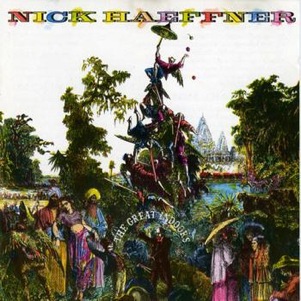
Nick Haeffner's 'The Great Indoors' is a great, lost, quintessentially English project. Echoes of Nick Drake, Kevin Ayers, John Cale, Pink Floyd and Robert Fripp loom large, but Haeffner's originality eclipses his folk, psych- and art-rock influences. There's a deftness, a lightness of touch here that is delightful. Vocally, he's no Caruso, but if you like Eno's vocal work, you'll love this. 'Steel Grey', 'Don't Be Late', and the title track are classic pastoral meditations. The album was recorded in the late eighties, but hasn't dated and is ripe for re-evaluation. listen here
domingo, 17 de junho de 2012
Hayvanlar Alemi - Guarana Superpower 2010
With their first real Western release only arriving on LP after a decade of playing in Ankara's clubs, Hayvanlar Alemi combine art music, psychedelia, and touches of the further exotic on Guarana Superpower. As guitarist Ozum Itez and percussionist/drummer Isik Sarihan move through the album, they delve into straightforward experimentalism in tracks like "Mega Lambada" and the title track. The duo touches on surf rock proper in the mood and instrumentation of "Snakesurfing," and briefly flirts with the fuzz-rock of Southeast Asia in "Mavi Sepet." Little ground is left uncovered in terms of electric guitar eclecticism here, with jazz, rock, and more infusing the whole and resulting in a large dose of psychedelia. Fine playing all around holds the set together, and makes it worth a listen. AMG. listen here
Neil Young And Crazy Horse - Americana 2012
Getting the band back together for the first time since 2003, Neil Young corrals Crazy Horse through Americana, a collection comprised primarily of old folk songs -- not the weird, forgotten ones scholars have excavated, but the familiar ones taught in elementary schools from sea to shining sea. Ornery git that he is, Neil doesn't follow his own concept to the letter, finding a way to shoehorn the Silhouettes' rocking doo wop classic "Get a Job" and the British commonwealth anthem "God Save the Queen" into Americana, their presence suggesting a possible political component to the record. Or perhaps those were the songs Young felt like playing that day. With an album as ungainly as Americana, either concept is possible and any clarity is crushed by the Horse's heavy-footed stomp. Here, once again graced by the presence of guitarist Frank Sampedro, who sat out 2003's rock opera Greendale, Crazy Horse stumble and lurch as they pound the same three chords they've been bashing out for 40 years, time not adding acumen but rather eroding whatever finesse they ever possessed. Always garage rock primitives, Crazy Horse sounds downright amateurish on Americana, as if they woke up one morning and couldn't remember how to play their instruments. Each cut plays like a first take, none worse than "Get a Job," where the band struggles mightily to achieve some semblance of swing and misses. Sometimes, this cacophony can be oddly compelling, particularly when a children's chorus -- the better to underscore these songs' origins, perhaps -- are brought into the mix, inevitably leading to everybody tripping over each other. It all winds up as an ungodly mess: Crazy Horse do, as Young asserted they would, make these songs their own, but by doing so, they've made them so nobody else would ever want them. AMG. listen here
Adrian Belew - Young Lions 1990
Young Lions is as solid an album as Adrian Belew had put out in some time, including his work with the Bears. Apparently, the relative chart success he had with his last effort fueled the desire for another single, and no less a luminary than former employer David Bowie was brought in to write and duet with Belew on "Pretty Pink Rose" (they even did a video to support it). While that song and "Gunman" (the pair's second collaboration on the album) are little more than a reprise of Bowie's work with Tin Machine, they clearly relieve Belew from having to scrap together all the material himself. Leaning on a not-too-distant King Crimson standard, "Heartbeat," and the Traveling Wilburys' "Not Alone Anymore" leaves Belew holding the bag for an even half-dozen originals, which reduces the filler ratio that plagued some of his earlier efforts. From the energetic opener, "Young Lions," to the Motown-inspired "Looking for a U.F.O.," Belew comes up with some off-center pop/rock songs that hold up under inspection. His work with the Bears had smoothed out the guitarist's rough edges, but on his own, Belew is more nimble and quirky, as "Men in Helicopters" and "Small World" demonstrate. Like Mr. Music Head before it, Young Lions presents Belew's assets in a very palatable package. Despite the lack of a real standout single, Belew's one-man performance on Young Lions is worth hearing. AMG. listen here
quarta-feira, 13 de junho de 2012
Caetano Veloso - Livro 1997
Caetano Veloso continues his free-thinking explorations of tropicalismo on this ambitiously arranged, elaborately packaged suite of songs devoted to whatever happens to cross his mind. Veloso says that he was listening a lot to the collaborations of Miles Davis and Gil Evans around this time, and Jaques Morelenbaum's charts often reflect their darkly urbane ethos. Yet for Morelenbaum's yin there is also the yang of the battering Bahian percussion that dominates many of the rhythm tracks. "Livros" in Portuguese means "books," so Veloso gives you a sample of his book Verdade Tropical in the booklet notes and pays eloquent tribute to them on the title track: "Books are transcendental things/But we can love them with our hands." He is alternately awestruck and appalled by the ambiguities of New York City on "Manhata"; here, the arrangement definitely contains haunting echoes of Evans. He can venture into atonality on "Doideca" (12-tone, but pointedly translated in the booklet as "loony"), recite the horrors of a slave ship voyage, tell someone off ("Nao Enche," which means "Piss Off"), or simply sing "How beautiful could a being be" over and over, presumably to a child, in falsetto to a hot groove. One of the most amazing songs is an epic about the life of Alexander the Great; it comes off like a great saga song. Finally, he runs down a long list of all his favorite Brazilian singers, seemingly leaving out no one, only to close with "Better than this there's only silence/And better than silence, only Joao." Can't add anything to that, except don't miss this CD if you love Brazilian music. AMG. listen here
Camper Van Beethoven - Popular Songs of Great Enduring Strength and Beauty 2008
Popular Songs of Great Enduring Strength and Beauty collects 18 cuts from mercurial post-punk/indie pop/garage folk legends Camper Van Beethoven, marking the group's first foray into the murky world of the "career overview." Like the band's nearly 25-year career, Strength and Beauty is built on the CVB holy trinity of endurance, charisma, and attitude, all three of which were put to the test when the band approached Virgin Records about buying back the rights to 1988's Our Beloved Revolutionary Sweetheart and 1989's Key Lime Pie. In keeping with big-label stereotypes, the answer was no, so CVB re-recorded five tracks for the anthology, doing everything in their power to re-create the magic as faithfully as they could. David Lowery's voice tries admirably to emulate its '80s incarnation on classics like Key Lime's "All Her Favorite Fruit" and "When I Win the Lottery," and the musicianship and production are top-notch, but fans who held those final two records close to their hearts during the ensuing Cracker years will notice the difference. That said, the rest of the album is top-notch, featuring enough instant classics like "Take the Skinheads Bowling" and "The Day That Lassie Went to the Moon" to turn a whole new generation on to punk-infused, ska-kissed Americana. At best, it's a tasty sampler on which to judge whether or not a listener is ready to dive into the mammoth five-disc Cigarettes & Carrot Juice: The Santa Cruz Years, and it dutifully doles out all of the quirky charm, genre-bending musicianship, and good-natured invective that infected so many people during the band's heydays. AMG. listen here
Peter Cetera - Peter Cetera 1981
Having tasted success with Chicago throughout the '70s, Peter Cetera decided to launch his solo career at the dawn of the '80s with this ten-track exercise in rock. In an immediate departure from the successfully safe formula Chicago utilized to exhaustion, Cetera employed a stellar crew of guest artists to reinforce that this was his project. The Beach Boys' Carl Wilson and Ricky Fataar make guest appearances, as does Toto wunderkind Steve Lukather, to complement Cetera's distinctive voice and bass playing. They waste no time in getting going with the rocker "Livin' in the Limelight," which features Lukather delivering a blazing guitar solo and Cetera trying to be as hard rocking as any soft rocker could possibly be. Think Don Johnson's "Heartbeat" and you're still nowhere close. Things simmer down a bit, and even return to Chicago-friendly territory, with "Mona Mona" and "On the Line." But the mandate remains the same: to distinguish this record as a solo endeavor, even though many songs here would lay the blueprint and signal the direction Chicago would take with Chicago 16 and the chart-topping juggernaut Chicago 17. For anyone but die-hard Chicago/Cetera fans, this is nothing more than a passing fancy, and those looking for Cetera's safe and accessible ballads will be mildly disappointed. But fans of early-'80s rock will be pleasantly surprised if they approach this record with open ears. AMG. listen here
Subscrever:
Mensagens (Atom)


